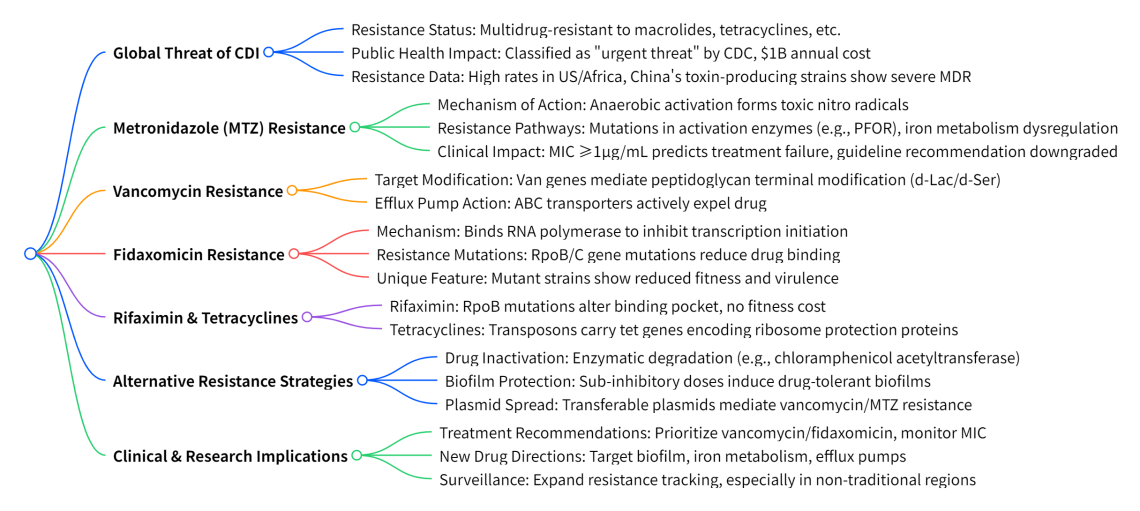
Clinical Insights: Resistance Mechanisms of Common Drugs for Clostridioides difficile Infection
Clostridioides difficile (CD) infection (CDI) remains a pressing global health challenge, driven by increasing antimicrobial resistance (AMR) and the bacterium’s ability to thrive in gut environments disrupted by antibiotics. Let’s explore how CD develops resistance to commonly used drugs, why this matters for treatment, and what it means for future therapies.
The Growing Menace of CDI and Antibiotic Resistance
CD is a spore-forming bacterium well-known for resisting multiple antibiotics like macrolides, tetracyclines, and fluoroquinolones. When broad-spectrum antibiotics wipe out the protective gut microbiota, CD takes advantage, overgrowing and producing toxins that cause severe diarrhea, colitis, and even life-threatening complications. Since 2013, the U.S. CDC has labeled CD as an “urgent threat,” estimating it costs the U.S. healthcare system $1 billion annually.
Current first-line treatments for CDI include metronidazole (MTZ), vancomycin, and fidaxomicin. But worrying trends have emerged: a study in Houston found 26% of CD strains were not fully sensitive to vancomycin and 29% to MTZ, while a Nairobi study reported even higher rates—67% and 85%, respectively. In China, although MTZ and vancomycin used to work reliably, recent research showed 15.6% resistance to MTZ and 36.3% to tetracyclines in some strains, with toxin-producing CD strains being far more likely to resist multiple drugs (96.4%) than non-toxin producers (31.4%).
How CD Evades Common Treatments
1. Metronidazole (MTZ): Breaking the Activation Chain
MTZ, a nitroimidazole antibiotic, starts as an inactive “prodrug” that needs activation in the low-oxygen environment of anaerobic bacteria. Enzymes like pyruvate flavodoxin oxidoreductase (PFOR) help convert it into toxic compounds that kill bacteria. Resistance often happens when mutations disrupt these activation enzymes or when iron metabolism—critical for PFOR’s function—goes haywire. Without proper activation, MTZ can’t do its job.
In clinics, higher MTZ resistance (MIC ≥ 1 μg/mL) directly links to treatment failure: nearly 30% of initial treatments fail, and 23% of patients relapse. As a result, guidelines now suggest using MTZ only when vancomycin or fidaxomicin aren’t options, mainly for milder CDI cases.
2. Vancomycin: Changing Targets and Pumping Out Drugs
Vancomycin works by binding to a specific part of the bacterial cell wall (d-Ala-d-Ala) to block its formation. CD resists this in two ways:
- Target modification: Genes like vanA or vanC change the cell wall’s terminal structure from d-Ala-d-Ala to d-Ala-d-Lac or d-Ala-d-Ser, making it hard for vancomycin to stick. VanA and vanB cause high-level resistance, while vanC, vanE, and vanG lead to lower-level resistance.
- Efflux pumps: Specialized proteins (ABC transporters) act like tiny pumps, pushing vancomycin and other drugs out of the bacteria before they can work, especially when triggered by host antimicrobial peptides.
3. Fidaxomicin: Mutations with a Side Effect
Fidaxomicin blocks bacterial RNA polymerase, stopping gene transcription. Resistance here comes from mutations in the RNA polymerase subunits (RpoB or RpoC), which alter the drug’s binding site. Interestingly, these resistant strains pay a price: they grow slower, produce fewer toxins, and are less virulent in animal models. The gut’s natural microbiota may even help limit their spread by outcompeting these weakened strains during treatment.
4. Rifaximin and Tetracyclines: Genetic Tricks and Rapid Adaptation
- Rifaximin, a rifamycin drug, faces resistance through mutations in the RpoB protein that change its binding pocket. Unlike in other bacteria, these mutations don’t weaken CD, allowing resistance to develop quickly—even during ongoing treatment.
- Tetracyclines target the bacterial ribosome to halt protein production. CD uses mobile genetic elements (like transposons Tn916) carrying tet genes to produce proteins that shield the ribosome, making tetracyclines ineffective.
Beyond Direct Drug Targets: Other Resistance Tactics
CD has more tricks up its sleeve:
- Drug destruction: Enzymes like chloramphenicol acetyltransferase (from transposons) or β-lactamases break down antibiotics before they can act.
- Biofilm protection: Low drug doses can actually help CD form biofilms—sticky bacterial communities that are far harder to kill, resisting up to 100 mg/L of MTZ and 20 mg/L of vancomycin.
- Plasmid-mediated spread: Transferable plasmids (e.g., pX18-498 for vancomycin resistance) shuttle resistance genes between strains, speeding up the spread of AMR.
What This Means for Patients and Research
Understanding these mechanisms is key for:
- Smarter treatment choices: Prioritize vancomycin or fidaxomicin for severe CDI to avoid MTZ resistance; test drug sensitivity (MIC) to tailor therapies.
- New drug discovery: Focus on understudied vulnerabilities like biofilm formation, iron regulation, or efflux pumps.
- Better monitoring: Expand resistance tracking, especially in regions where CD isn’t currently well-monitored, to catch emerging threats early.
As CDI becomes a tougher opponent, combining insights from genetics, microbiome science, and drug development will be crucial to stay ahead of resistance and improve patient care.
Antimicrobial resistance (AMR) is a significant threat to global public health. Clostridioides difficile (CD) is an important multidrug – resistant bacterium, often showing multidrug resistance to macrolides, lincosamides, tetracyclines, cephalosporins, and fluoroquinolones. This characteristic enables CD to grow dominantly when broad – spectrum antibacterial drugs cause intestinal flora imbalance, produce toxins, and thus cause Clostridioides difficile infection (CDI). At the same time, its spore – producing property can lead to the widespread transmission of CD within medical institutions. Since 2013, CD has been listed by the Centers for Disease Control and Prevention (CDC) of the United States as the most urgent public health threat, causing a loss of $1 billion to the US healthcare system every year. As of 2019, the US CDC still included it among the five urgent threats of antibiotic resistance.
At present, the antibacterial drugs recommended for the treatment of CDI in clinical practice include metronidazole (MTZ) and vancomycin.
And fidaxomicin. In addition, some studies have shown that tigecycline can effectively treat severe CDI, and rifaximin may help prevent CDI recurrence. However, in recent years, it has been found that the sensitivity of CD to these drugs has decreased compared with previous levels. The results of a study from Houston, USA, showed that 26% of the fecal isolates from CDI patients were insensitive to vancomycin and 29% were insensitive to MTZ; while another study conducted in Nairobi, Kenya, showed that the proportion of isolates insensitive to the two drugs could be as high as 67% and 85%. At the same time, reports of treatment failure with these two drugs are not uncommon. In China, Clostridioides difficile is not within the scope of pathogens monitored by the CARSS and CHINET bacterial resistance monitoring networks, but some small-scale epidemiological studies still suggest the existence of drug-resistant strains. A meta-analysis showed that from 2007 to 2013, the resistance rate of clinically isolated Clostridioides difficile in China to rifampicin was 18.3%, the resistance rate to tetracycline was 46.8%, and it was completely sensitive to metronidazole and vancomycin. Among 411 Clostridioides difficile strains isolated from the feces of diarrhea patients in two tertiary hospitals in Hangzhou, Zhejiang from 2012 to 2015, 15.6% were resistant to metronidazole, 36.3% were resistant to tetracycline, all strains were sensitive to vancomycin, and the multi-drug resistance rate of toxin-producing strains (96.4%) was much higher than that of non-toxin-producing strains (31.4%). The mechanisms of Clostridioides difficile resistance to antibacterial drugs are diverse.
The resistance mechanisms of Clostridioides difficile to commonly used antibacterial drugs for the treatment of CDI in clinical practice
Several major types of antibacterial drug resistance mechanisms in bacteria are relatively common in Clostridioides difficile. Clostridioides difficile can cause the failure of antibacterial drugs by altering the drug structure: For example, the chloramphenicol acetyltransferase encoded by catD carried on transposons Tn4453a and Tn4453b acetylates the primary hydroxyl group of chloramphenicol, leading to drug inactivation and preventing it from binding to the 50S ribosomal subunit of bacteria; In addition, some CD strains encode class D β-lactamases that can destroy the β-lactam ring, rendering cephalosporin drugs inactive. Clostridioides difficile can also modify the targets of antibacterial drugs: For example, the expression of the vanCd operon can cause the modification of d-Ser at the end of the CD peptidoglycan precursor, reducing the affinity of this site for vancomycin. To date, more than ten resistance mutations have also been found in the rifampin resistance determining region (RRDR) of RpoB in CD clinical strains, which may impede the binding of rifamycin drugs to the target RpoB protein. Clostridioides difficile encodes different families of transporters to actively efflux antibacterial drugs: For example, the MATE family transporter encoded by cdeA in CD is related to fluoroquinolone resistance, while the ABC family transporter CprABC mediates the resistance of CD to antimicrobial peptides. The formation of biofilms is also involved in the drug tolerance of Clostridioides difficile: Sub-inhibitory concentrations of vancomycin and metronidazole can enhance the formation of CD biofilms, and at the same time, CD biofilms can tolerate higher concentrations of metronidazole (10 – 100 mg/L) and vancomycin (20 mg/L). In addition, some previously unconsidered mechanisms, such as transferable plasmid-mediated resistance (presumably the vancomycin resistance plasmid pX18 – 498 encoding N-acetylmuramoyl-L-alanine amidase, the metronidazole resistance plasmid pCD-METRO, etc.), may also play an important role in the antimicrobial resistance (AMR) of Clostridioides difficile.
Metronidazole
MTZ is a nitroimidazole antibiotic and has been the drug of choice for the treatment of mild to moderate CDI since the late 1990s. However, since the emergence of the epidemic strain NAP1/027, strains with low-level and heterogeneous resistance to MTZ have been reported successively in many countries. In recent years, even high-level resistant strains have been isolated. Reports of CDI cases with reduced response to MTZ treatment have also become increasingly common.
MTZ is a prodrug. After being ingested by bacteria, it is reduced and activated through an enzymatic reaction with a low redox potential unique to anaerobic bacteria in the cell. After the heterocyclic ring fissions, hydroxyethylhydroxamic acid and acetamide are formed. The bactericidal mechanism of MTZ is not yet clear. It may be that the nitro free radicals generated during the activation reaction are bacteriotoxic to anaerobic bacteria, leading to bacterial death.
The resistance of CD to MTZ may also involve multiple mechanisms. One of them is the alteration of the drug reduction and activation pathway. Electron transfer proteins involved in the drug redox reaction, such as pyruvate flavodoxin oxidoreductase PFOR, play an important role in this enzymatic reaction. Mutations in the genes encoding these proteins are involved in the formation of drug resistance. Iron ions, as components of electron transfer proteins such as PFOR, are functional.
Iron ions, as important elements of functional prosthetic groups (such as iron-sulfur clusters) that make up electron transfer proteins like PFOR, play an important role in the MTZ reduction and activation pathway. Therefore, changes in iron metabolism/ homeostasis are also considered to be related to CD resistance to MTZ.
The resistance of Clostridioides difficile to metronidazole may be related to the decline in the clinical efficacy of metronidazole. Recent studies have shown that a minimum inhibitory concentration (MIC) of metronidazole (MTZ) ≥ 1 μg/mL for Clostridioides difficile is an independent predictor of clinical treatment failure in MTZ-based initial treatment regimens. Two multi-center cohort randomized controlled trials (RCTs) from the United States and Europe have shown that the initial treatment failure rate of Clostridioides difficile infection (CDI) under the standard MTZ regimen is close to 30%, and the overall probability of subsequent CDI recurrence reaches 23%. Both indicators are inferior to those of vancomycin. Therefore, the status of MTZ in the guidelines of Europe and the United States has declined in the past five years. It is only recommended for the treatment of patients with mild to moderate CDI in the initial episode who cannot tolerate or obtain vancomycin/fidaxomicin.
Vancomycin
The most common vancomycin resistance mechanism is the modification of drug targets mediated by van genes, resulting in a decrease in the affinity of vancomycin for the cell wall. The van gene family mainly mediates two types of terminal modifications, d-Lac or d-Ser. Among them, the d-Lac modification (d-Ala-d-Lac) is encoded by the vanA and vanB gene clusters, which can lead to high-level vancomycin resistance; the d-Ser modification (d-Ala-d-Ser) is encoded by the vanC, vanE, and vanG gene clusters, which can lead to low-level resistance. Multidrug efflux pumps are active transport proteins present in the bacterial cell membrane. One of the major families is the ATP-binding cassette (ABC) transporters, which hydrolyze ATP for energy and transport and efflux simple ions or macromolecular solutes such as antibacterial drugs. Studies have confirmed that transporters are the main cause of multidrug resistance in several Clostridium species. In CD, the cationic antimicrobial peptide (cathelicidin antimicrobial peptide, CAMP) can induce high expression of the ABC transporter operon, thereby reducing the effectiveness of various CAMPs.
Fidaxomicin
The narrow – spectrum antibacterial drug fidaxomicin binds to the clamp – like domain of bacterial RNA polymerase (RNAP), inhibiting the initiation step of DNA transcription. Since 2011, the US Food and Drug Administration has approved fidaxomicin for the treatment of CDI.
Fidaxomicin resistance is derived from mutations in the RNAP binding sites, including various mutations such as RpoB (Gln1074Lys, Val1143Asp, Gly, Phe) and RpoC (Gln781Arg, Asp1127Glu, Asp237Tyr). Among them, Val1143Asp (MIC>64 mg/L) and Val1143Gly (MIC = 16 mg/L) are also present in fidaxomicin-resistant clinical isolates of Clostridioides difficile (CD). The Val1143Asp mutation in RpoB affects the fitness and virulence of CD. Compared with its parental strain R20291, the laboratory strains with Val1143Asp and Val1143Gly mutations have slower overall growth, reduced competitive fitness, decreased production of toxins A and B, and also reduced virulence in the golden hamster model of CDI.
Since such drug-resistant mutations are accompanied by a decrease in fitness, and the narrow-spectrum activity of fidaxomicin has a relatively minor impact on the gut microbiota,
Therefore, if drug-resistant mutations occur during the treatment process, the symbiotic multiple gut microbiota may help mitigate the impact of the mutations.
Rifaximin and tetracyclines
Rifaximin inhibits bacterial RNA polymerase. Mutations in the β subunit of bacterial RNA polymerase, RpoB, are the main mechanism for the development of rifamycin resistance. These mutations disrupt the direct interaction between rifamycin and RpoB or alter the structure of the rifamycin-binding pocket on RpoB.
Multiple RpoB mutations that can cause drug resistance have been identified in CD, including Ser488Tyr, Asp492Tyr, His502Asn/Tyr, Arg505Lys, and Ser550Phe/Tyr. Unlike other strains (such as Neisseria meningitidis and Mycobacterium tuberculosis), RpoB mutations lead to rifamycin resistance in CD without incurring in vitro and in vivo fitness costs. The development of rifamycin resistance in CD is rapid, and some studies have shown that resistance may even occur during the use of rifaximin for CDI, resulting in poor clinical outcomes.
Tetracyclines are broad-spectrum antibacterial drugs that target the bacterial 30S ribosome and can prevent aminoacyl-tRNA from binding to mRNA, thereby inhibiting protein translation. Compared with rifaximin, CD has a lower resistance rate to tigecycline. CD mediates the development of tetracycline resistance through ribosome protection proteins, namely elongation factors, encoded by various tet genes (such as tetM, tetW, tetA(P) and tetB(P)) carried by transposons (such as Tn916, Tn5397 and Tn4453).
With a better understanding of the evolution of drug resistance and resistance mechanisms, it will provide a theoretical basis for the rational use of antibacterial drugs, the containment of the emergence and spread of drug-resistant bacteria, and the development of new antibacterial drugs and rapid detection kits for new drug-resistant bacteria.


You May Also Like

A Rare Case of Mycobacterium haemophilum Infection in a Patient with Dual Autoimmune Diseases: Lessons for Clinicians

Tackling Tuberculosis in Thailand: A Groundbreaking Study on Combining Detection and Prevention