-
Macroevolution Reveals Hidden Antibiotic Resistance and a New Rifabutin-Threatening Enzyme
Antibiotic resistance is one of the few problems that gets worse the longer we ignore it. Every year, infections that were once routine to treat become harder to manage, and the pipeline of new drugs has not kept pace with bacteria evolving around them. Most of the methods we use to find resistance mechanisms were built for a different era, one focused on a single patient, a single strain, a single mutation. A growing body of work now suggests we have been looking in too small a frame. By stepping back and comparing entire species within a bacterial genus, what researchers call a macroevolutionary view, we can surface resistance strategies…
-
The Remarkable Story of Rifamycin: How an Accidental Discovery Changed the Fight Against Tuberculosis
In the late 1950s, a group of Italian researchers working with soil samples stumbled upon something extraordinary. They had no idea that their curiosity would lead to one of the most important antibiotic families in medical history. This is the story of rifamycin—a drug that would transform how we treat tuberculosis and save countless lives along the way. The Birth of a Medical Revolution The discovery happened almost by accident. Scientists at Lepetit Pharmaceuticals in Milan were studying soil bacteria when they noticed something interesting: a strain of Amycolatopsis mediterranei was producing compounds that could stop other bacteria from growing. They called these compounds rifamycins. Within years, rifampicin (a semi-synthetic…
-
The Battle Against Antimicrobial Resistance: Unpacking Molecular Mechanisms of Newly Approved Antibiotics (2017-2025)
In the realm of global public health, few threats loom as large as antimicrobial resistance (AMR). Imagine a world where once-treatable bacterial infections—from urinary tract infections to life-threatening pneumonia—become untreatable. This isn’t science fiction; it’s a growing reality as bacteria evolve to outsmart the drugs designed to kill them. The World Health Organization (WHO) has sounded the alarm, classifying pathogenic bacteria into three risk tiers (critical, high, and medium) to prioritize AMR prevention and control. But there’s a glimmer of hope: between 2017 and 2025, 15 new antibiotics received approval from regulatory giants like the U.S. Food and Drug Administration (FDA) and the European Medicines Agency (EMA). Yet, even these…
-
Clinical Insights: Resistance Mechanisms of Common Drugs for Clostridioides difficile Infection
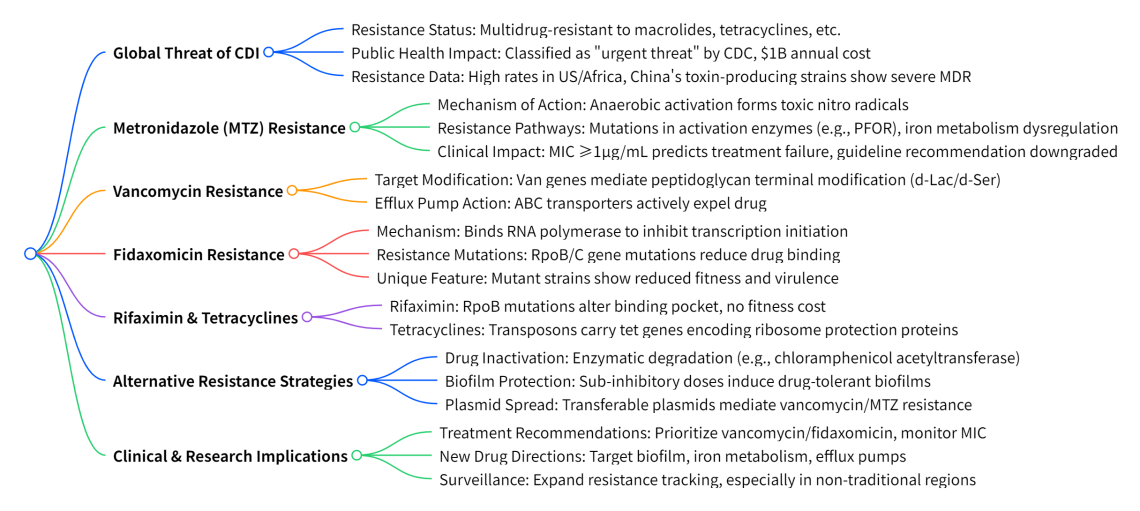
Clostridioides difficile (CD) infection (CDI) remains a pressing global health challenge, driven by increasing antimicrobial resistance (AMR) and the bacterium’s ability to thrive in gut environments disrupted by antibiotics. Let’s explore how CD develops resistance to commonly used drugs, why this matters for treatment, and what it means for future therapies. The Growing Menace of CDI and Antibiotic Resistance CD is a spore-forming bacterium well-known for resisting multiple antibiotics like macrolides, tetracyclines, and fluoroquinolones. When broad-spectrum antibiotics wipe out the protective gut microbiota, CD takes advantage, overgrowing and producing toxins that cause severe diarrhea, colitis, and even life-threatening complications. Since 2013, the U.S. CDC has labeled CD as an “urgent…

Professional manufacturer of Rifamycin derivatives since 1994