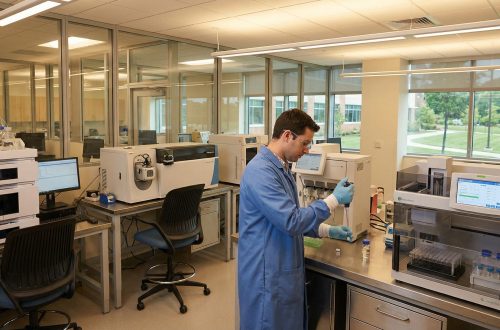
Flow-Through Cell Method: The Smarter Way to Test Poorly Soluble Drugs
Anyone who has tried to pull a clean dissolution profile out of a poorly soluble compound knows the feeling. The standard basket and paddle work fine for a lot of products, but the moment you move into low-solubility actives, pH-dependent release, or anything that does not behave like a plain tablet, those methods run out of room. The flow-through cell method, also known as the flow cell method or USP Apparatus 4, has become the tool many people reach for when the usual approaches stop working.
This piece covers what the method is, how the apparatus is put together, which parameters actually change the result, and where it has shown its worth across ordinary tablets, awkward special dosage forms, and even drug-eluting devices.
Why dissolution testing matters
Dissolution testing measures how fast and how completely an active drug leaves a solid oral dosage form, whether that is a tablet, a capsule, or granules, under set conditions. For modified-release products the same idea goes by release testing. The goal is to copy what happens in the gut: the form breaks apart, the drug dissolves, and only the dissolved part can be absorbed. A dissolution profile is one of the best in vitro signals we have for predicting how much of the drug actually reaches the body and whether the therapy will work.
The problem is that the gut is a moving target. pH shifts as contents travel from the stomach into the intestine. Things churn. Material keeps moving along. Older closed-vessel methods struggle to replay that sequence, which is a big reason the flow-through cell keeps gaining ground for difficult products.
What the flow-through cell method is
The method pumps dissolution medium continuously through a small sample cell that holds the dosage form. Medium is pulled from a reservoir, pushed through the cell at a controlled rate, passed through a filter, and then either sent back to the reservoir (closed loop) or thrown away and replaced with fresh medium (open loop). That simple “medium flows past the sample” setup is what gives the method its flexibility.
The idea is not new. Early versions in the 1950s and 1960s used a reservoir, a pump, and a chamber to move medium past a product. The first commercial flow cell came out in the 1970s. Pharmacopeias took it up through the 1990s: the U.S. Pharmacopeia added it in 1995, the British Pharmacopeia in 1993, the Japanese Pharmacopeia in 1996, and the Chinese Pharmacopeia included it formally in 2020. It now sits next to baskets, paddles, and reciprocating cylinders in the major compendia, and it is often the first choice when the standard methods fall short.
What sets it apart
A few things make the flow-through cell different from a basket or paddle:
- It avoids saturation artifacts. Because the medium keeps moving, you do not get the local equilibrium, adsorption, or concentration buildup that can skew results in a static vessel.
- It can change pH mid-run. Open-loop setups let you switch to a different pH channel partway through, which is about as close as we get to replaying the stomach-to-intestine transition.
- It handles odd volumes. You can run with under 400 mL or over 1000 mL of medium, ranges the traditional apparatus simply cannot reach.
- It has cells built for awkward products. Implant cells, suppository cells, and others are made for the job, so special dosage forms get tested fairly instead of forced to fit.
- It is easy to run for modified release. No manual top-up; you just switch channels to change the medium.
- It fixes instability from short residence time. Constant fresh medium bathing the sample prevents the degradation that can happen when a compound sits in solution.
- It holds sink conditions well, which supports a stronger in vitro to in vivo correlation, or IVIVC.
Those traits explain why the method has such a wide reach across new and complex dosage forms.
How the apparatus is built
A typical flow-through system has a solvent reservoir, a constant-flow pump, a heated water bath, the sample cell, a filter, and a fraction collector. The key split is between closed-loop and open-loop operation.
Closed loop sends medium from the reservoir through the bottom of the cell, past the sample, through a top filter, and back to the reservoir. Concentration climbs over time until the drug is gone. It handles tablets, capsules, granules, suspensions, softgels, implants, suppositories, pellets, oily liquids, and gels. It also removes the adhesion, floating, and sampling problems you hit with paddles. The limit is reservoir size, which caps medium near 1000 mL, so closed loop is a poor fit for poorly soluble drugs.
Open loop does not return medium to the bottle. The sample sits in medium that is constantly refreshed, which keeps sink conditions intact and makes it work for poorly soluble compounds. It can also switch pH channels mid-experiment, which matters for pH-sensitive targeting and site-specific delivery systems.
Sample cells are sized and shaped for the product, with tablet cells, implant cells, and suppository cells differing inside. Standard tablet cells come in a 12 mm small version and a 22.6 mm large version by inner diameter. A metal holder clip fixes the sample so position does not drive the result. Coated tablets usually sit with the clip V-up; capsules flip it the other way. A groove in the cell wall seats the clip in the center and keeps the sample from floating.
Some labs have built their own cells. One group used a 10 mm syringe with zirconia beads for laminar flow, a 200-mesh screen to hold the product, and a peristaltic pump for delivery.
The parameters that move the needle
Flow rate
Flow rate decides a lot. The method allows 1.5 to 50 mL/min, with standard compendial rates of 4, 8, and 16 mL/min. The 16 mL/min setting is common because in one hour it pushes about 960 mL through the cell, close to what basket and paddle methods use. Studies keep showing that, at a fixed time, more drug dissolves at higher flow rates.
Medium
Medium choice matters as much as anything. Traditional methods struggle outside 400 to 1000 mL, but the flow cell works there. In closed loop you pick a volume that fits the drug and the product; in open loop you tune flow rate and runtime to hit the volume you need. Dissolution mostly happens in the stomach, small intestine, and large intestine, so media are usually staged to mimic those pH zones, and open loop can shift pH in real time the way the gut does.
For poorly soluble drugs, surfactants often go into the medium. Both the type and the concentration count; higher surfactant levels generally speed up and increase dissolution.
Hydrodynamics: laminar versus turbulent
Putting glass beads in or taking them out at the bottom of the cell lets you simulate two flow regimes. Laminar flow is layered and orderly, with low shear, and it best mimics a food-filled gut, giving even release without a burst. Powders, suspensions, and pellets usually use laminar flow, with beads mixed into the product or arranged sandwich style. One study found atorvastatin nanoparticles, a BCS Class II drug, would not fully release in a basket within 60 minutes but did so in the flow cell’s laminar mode with 1 mm beads. Take the beads out and the medium runs as turbulent flow, more abrupt, mimicking the friction of a fasted gut or the washing a stent meets in blood.
Where the method earns its keep
Oral solid dosage forms
For tablets, the flow-through cell builds better IVIVC than baskets or paddles because it replays the gut’s sequential pH, hydrodynamics, and transit. In a nimodipine study, paddle dissolution ran far faster than actual absorption, while the flow cell matched it. The flow cell also caught quality gaps between a generic and a reference product, incomplete and poorly reproducible release, that the paddle could not tell apart.
In poorly soluble drugs, the open loop keeps pulling dissolved drug out and pumping fresh medium in, and it can shift pH to mirror the gut. Carbamazepine work comparing four generics to the originator shows this clearly. All four met the legal limit in the paddle, with f2 above 50 and no significant difference, meaning they looked like the originator. The flow cell told a different story: none hit the 15-minute target, one failed even at 60 minutes, and all differed significantly from the originator, with f2 below 50. The flow cell was the more discriminating method.
For capsules, work across 91 manufacturers and 91 batches of amoxicillin showed the flow cell’s hydrodynamics track physiology better, so its dissolution curve follows the in vivo absorption curve more closely.
Special dosage forms
Beyond tablets and capsules, the method has been used on softgels, powders, creams, lozenges, granules, matrix tablets, nanoparticles, microspheres, vascular implants, suspensions, nanosuspensions, eye drops, and osmotic pumps. A few examples:
- Patches. Nicotine transdermal patches tested by flow cell matched paddle-over-disk results, no significant difference, which supports using it for consistency checks.
- Suppositories. Older methods fight floating samples and volume limits. The flow cell stops the floating and sets volume freely; one study used a 200 mL closed-loop volume to characterize a traditional Chinese medicine suppository where paddles and baskets gave levels too low to measure.
- Creams. The rotating cylinder method cannot test backless creams, so the flow cell stepped in. A semisynthetic membrane-wrapped sample in a 22.6 mm cell, 200 mL, closed loop, revealed clear release differences between manufacturers of a compound ketoconazole cream.
- Osmotic pump tablets. In open loop at 8 mL/min, the method separated how different plasticizers changed release rate, giving formulation screening a new angle.
- Suspensions. It told an immediate-release salt from a sustained-release pamoate salt of pramipexole apart and modeled the release mechanism, and it handled viscous nanosuspensions where paddle and reverse dialysis struggled.
Drug-eluting stents
For drug-coated stents, release rate is a safety-critical quality attribute. The flow cell resembles the washing a stent meets in blood flow. Work on cilostazol-loaded biodegradable fiber stents fit the data to release models and showed dissolution plus diffusion and polymer relaxation drives release. In a side-by-side of five marketed rapamycin stents under the same conditions, one showed severe burst release and another released too slowly, differences that would have stayed hidden if each were tested only against its own in-house standard.
Paired with other techniques
The flow cell also works with other instruments. Fiber-optic probes have mapped dissolution behavior of cefprozil under simulated gastric conditions. MRI-coupled flow cells have separated controlled-release mechanisms. Desorption electrospray ionization mass spectrometry imaging plus gas-phase ion mobility spectrometry has mapped drug distribution in polymer implants exposed to accelerated release media, something release rate alone cannot show.
Limits to keep in mind
The method is not free. For poorly soluble drugs, the open loop’s constant fresh medium helps release but uses volumes so large they may not reflect the body, so there is still work to do. Flow-rate calibration currently rounds to single digits, which adds some error. The instruments cost a lot, so cost, operability, and IVIVC trade-offs should guide the choice.
Bottom line
Traditional dissolution methods hit real walls as formulations get more complex and IVIVC expectations rise. The flow-through cell fills many of those gaps, and paired with other instruments it can explain release mechanisms rather than just measure them. Use is growing worldwide, though instrument development and application depth still trail in some regions. For anyone working on poorly soluble actives, pH-sensitive products, or novel dosage forms, it is worth a serious look.
You May Also Like

A Comprehensive Guide to Pharmaceutical Content Testing: Methods, Selection, and Optimization

Uncovering the Hidden Antimicrobial Resistance Crisis in COVID-19 and Dengue: New Insights from Metatranscriptomics